The Official Website of Robert M. Schoch  


A note to visitors of this website: 
I own two domains, www.robertschoch.com and www.robertschoch.org.  Others have purchased my name as a domain. 
I have no control over this, or what is posted on those sites.  The World Wide Web is the ultimate experiment in free
expression, and I understand this.  Thank you for your interest in my work.


The Parapsychology Revolution
:  Selections from fourteen seminal papers, 1886 – 2007,
by major figures in the field, plus 100 pages of commentary by Schoch and Yonavjak.


From the back cover of The Parapsychology Revolution:

Ground in scientific acumen and constructive inquiry, this anthology shines a rare, clarifying light on the controversial
realms of psychical and paranormal research, collecting key reports, essays, and arguments from more than a century of
investigation into matters such as clairvoyance, telepathy, and poltergeist activity.

Studies in the modern laboratory, employing rigorous methodology and peer-reviewed oversight, have conclusively
detected statistical anomalies suggesting the presence of some not yet understood faculty of the human mind.  In
The Parapsychology Revolution, Robert M. Schoch, Ph.D.—a scholar widely known for his geological theories that
question the conventional dating of the Great Sphinx—and researcher Logan Yonavjak introduce and anthologize the core
writings that underscore the range and continuing challenges of psychical research.

Serious in tone and intent, The Parapsychology Revolution provides a thorough documentary overview of the inception
and present-day state of this fascinating and important field of research.  The book’s extensive introduction and the editors’
commentary on individual essays and sections highlight milestones, feuds, and leading players that mark the nascent history
of paranormal and psychical investigation.

Special note is taken of episodes of fraud and their troubling persistence in the field.  The authors examine the work of
reputable scholars such as Ian Stevenson, William James, and J. B. Rhine, who did so much to legitimize the study of the
paranormal.  Finally, The Parapsychology Revolution addresses and clarifies the all-important question:  Is there
legitimate evidence for a world beyond the ordinary?


“A remarkably comprehensive overview of the broad study of the paranormal, tied together by balanced and thoughtful
commentary . . . A must-read for the serious student of the paranormal and the open-minded skeptic alike.”

                                                     Sally Rhine Feather, Ph.D., Rhine Research Center


Interview about The Parapsychology Revolution on Ghostvillage.com:   
http://www.ghostvillage.com/library/2008/lib_schoch.shtml

Interview about The Parapsychology Revolution on The Daily Grail:  http://dailygrail.com/features/schoch-interview-on-psi


                            Selected books by Robert M. Schoch


                                          Introduction

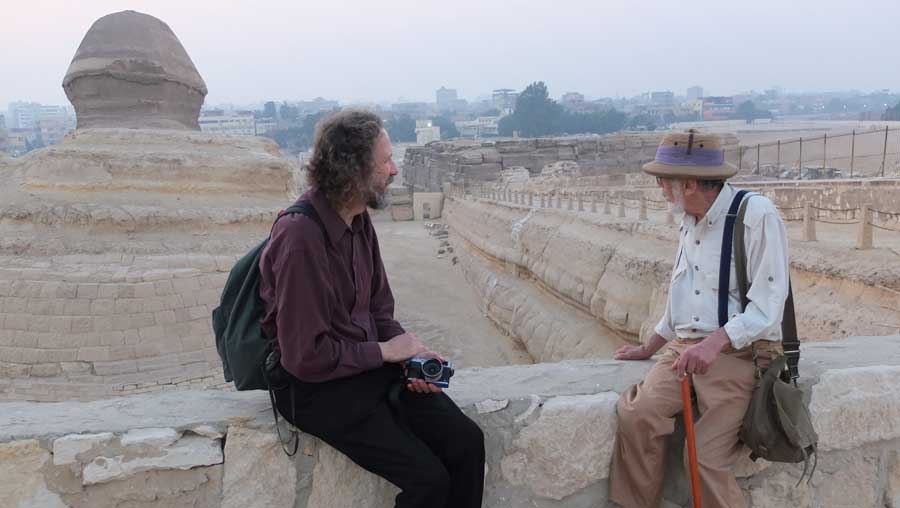
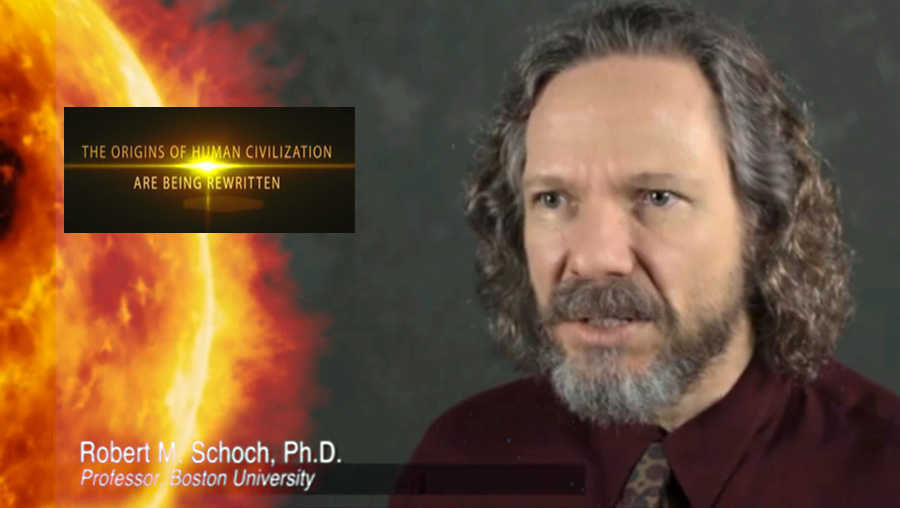
Dr. Robert M. Schoch, a full-time faculty member at the College of General Studies at Boston University since 1984, earned his Ph.D. in geology and geophysics at Yale University.  Schoch has been quoted extensively in the media for his pioneering research recasting the date of the Great Sphinx of Egypt, as well as for his work on ancient cultures and monuments in such diverse countries as Peru, Bosnia, Egypt, and Japan.  Schoch has appeared on many radio and television shows and is featured in the documentary The Mystery of the Sphinx.  Dr. Schoch is the author or coauthor of both technical and popular books, including the trilogy with R. A. McNally: Voices of the Rocks (1999), Voyages of the Pyramid Builders (2003), and Pyramid Quest (2005).  A recent project by Dr. Schoch is The Parapsychology Revolution:  A Concise Anthology of Paranormal and Psychical Research (Compilation and Commentary by Robert M. Schoch and Logan Yonavjak, Tarcher/Penguin, 2008). 


                          Robert Schoch spoke in Milan on April 20, 2008.


              Conference on Precession and Ancient Knowledge

For information on CPAK 2008, at which Dr. Schoch will be speaking, see:  http://www.cpakonline.com/


Dr. Schoch spoke at CPAK 2006 and CPAK 2007 (Conference on Precession and Ancient Knowledge).

Link to an excerpt from Robert Schoch’s presentation at CPAK 2007:
http://www.youtube.com/watch?v=XDofx2hKZRQ

For a press release about CPAK 2007, see:

http://www.mmdnewswire.com/authors-nd-scientists-to-meet-nd-rewrite-history-1922.html

Robert Schoch’s presentation at CPAK 2006 (Conference on Precession and Ancient Knowledge, 14 October 2006, University of California, Irvine) is available on DVD from VW Tapes / Von Wiegandt Productions.  See  
http://206.188.210.25/index.asp?PageAction=VIEWPROD&ProdID=10274

His presentation at CPAK 2007 (6 & 7 October 2007, University of California, San Diego) is available on DVD from VW Tapes / Von Wiegandt Productions.
See  http://206.188.210.25/index.asp?PageAction=VIEWPROD&ProdID=11536


                   Environmental Science and Natural History

Dr. Schoch is a coauthor of a college Environmental Science textbook: http://www.jbpub.com/catalog/0763742627/

Dr. Schoch is also a coauthor of a book on Hoofed Mammals.


                                         Sphinx Studies


An Abstract of a Paper titled EROSION PROCESSES ON THE GREAT SPHINX AND ITS DATING presented by Dr. Schoch at a June 1999 conference organized by the University of Bergamo and held in Bergamo and Milan:


Robert  Schoch, Boston University, Boston, USA

EROSION PROCESSES ON THE GREAT SPHINX AND ITS DATING


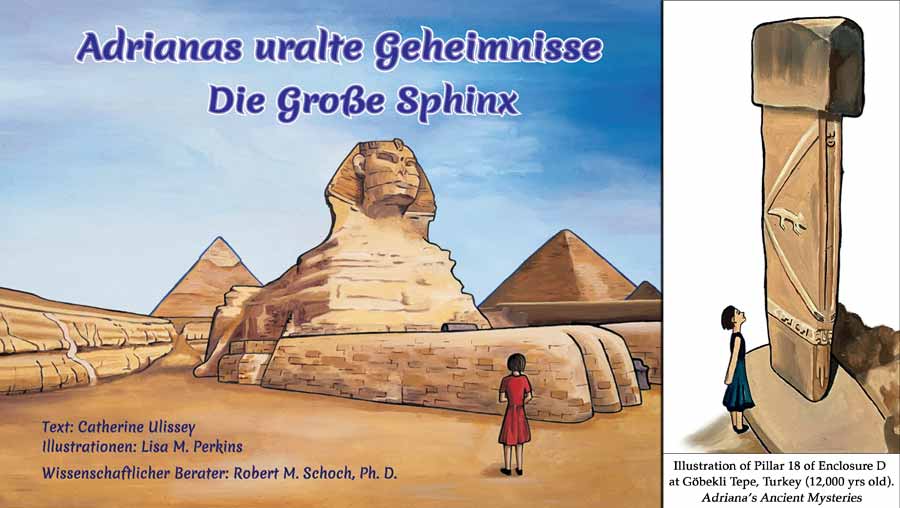
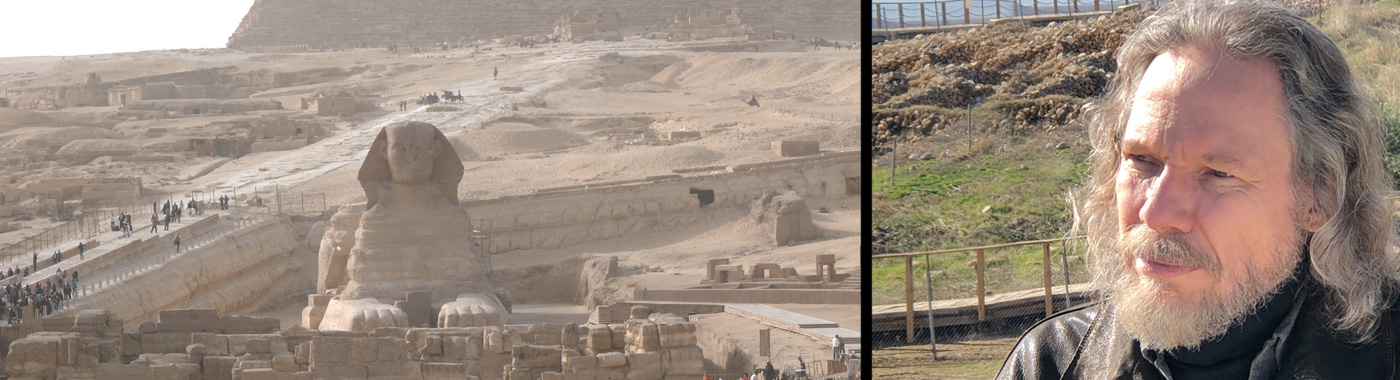
Many recent Egyptologists have attributed the carving of the Great Sphinx of Giza to the Old Kingdom Pharaoh Khafre (Chephren), ca. 2500 B.C. On the basis of a number of lines of geological, seismological, Egyptological, and related evidence, I have come to the conclusion that the structure commonly known as the Great Sphinx was built in stages (originally it may not have even been a Sphinx).  Initial carving of the core body of the Sphinx is estimated to have taken place during the period of approximately 7,000 to 5,000 B.C.  The Sphinx has subsequently been reworked and refurbished many times over the succeeding millennia -- including, probably, during the reign of Khafre.  In particular, the rump or rear of the Sphinx was carved out much later than the core body, and the head of the Sphinx has been recarved.

My geological work suggests that Khafre merely restored the Sphinx. The body of the Sphinx, carved from the local bedrock and thus sitting in the bottom of an artificial hollow (ditch), and the walls of the Sphinx enclosure exhibit well-developed precipitation-induced (p-i) weathering (characterized by a rolling and undulating vertical profile) not typically seen on Old Kingdom Giza Plateau structures (which exhibit primarily wind-induced weathering marked by a more angular profile with soft layers removed by wind abrasion) also excavated from the Mokattam limestone.  This deep p-i weathering of the Sphinx is interpreted as predating the current arid regime of the area, and thus indicates that the body of the Sphinx predates Old Kingdom times by perhaps several millennia.  Though we continue to refine our knowledge of the details of the paleoclimatic history of the Giza Plateau over the last 10,000 years, we already know enough to associate certain dominant modes of weathering with certain parts of that climatic history. Portions of the Sphinx predate Old Kingdom times. The temples adjacent to the Sphinx are built of limestone coreblocks taken from the ditch quarried out to form the body of the Sphinx.  These coreblocks are faced with Aswan granite attributed to Khafre, but the coreblocks were already deeply weathered when the granite facing was originally applied.  The first of several ancient repair campaigns to the weathered body of the Sphinx was done with typical Old Kingdom style masonry, but the core body of the Sphinx was already deeply weathered when this earliest repair work was carried out (see Robert M. Schoch, 1992, KMT, A Modern Journal of Ancient Egypt, vol. 3, no. 2, pp. 52-59, 66-70; Robert M. Schoch with Robert Aquinas McNally, 1999, VOICES OF THE ROCKS, New York: Harmony Books).  Corroborative evidence includes low-energy seismic refraction data that records up to 100% deeper weathering below the original floor of the Sphinx enclosure as compared to weathering seen in the identical limestones in an area presumably quarried during Khafre's time in the rear of the Sphinx enclosure. Seismic investigations have also uncovered a series of cavities or chambers under the Sphinx (see Thomas Dobecki and Robert M. Schoch, 1992, Geoarchaeology, vol. 7, no. 6, pp. 527-544).

Source: http://www.unibg.it/convegni/NEW_SCENARIOS/Abstracts/Schoch.htm 


For an article by Dr. Schoch discussing various aspects of the debate over the Age of the Great Sphinx, with photographs, see:  http://www.morien-institute.org/sphinx2.html  


Dr. Schoch contributed an article on the Great Sphinx to volume 1 (2007) of Dark Lore.
See
http://www.amazon.com/Darklore-Vol-1-Daniel-Pinchbeck/dp/0975720015/ref=pd_bbs_sr_1?ie=UTF8&s=books&qid=1196872955&sr=8-1


Announcement as of 8 December 2007:


The Sphinx Project GeoPanel:  Investigating the Nature and Implications of Weathering and Erosional Features Observed on the Great Sphinx of
Giza, Egypt

The standard modern Egyptological attribution of the Great Sphinx (Giza Plateau, Egypt) is to the Old Kingdom Fourth Dynasty, circa 2500 B.C.  This standard scenario attributes the weathering and erosional features seen on the body of the Sphinx and in the Sphinx Enclosure primarily to factors typical of an arid desert regime such as wind erosion, sand abrasion, and salt crystallization.  In contrast, we have presented evidence that the Great Sphinx and the Sphinx Enclosure were subjected to significant precipitation-induced weathering and erosion, apparently due to rain and attendant water runoff (see, for instance, R. M. Schoch and J. A. West, 1991, Geological Society of America abstracts with programs, v. 23, no. 5, p. A253; R. M. Schoch, 1992, KMT, A Modern Journal of Ancient Egypt, vol. 3, no. 2, pp. 52-59, 66-70; R. M. Schoch and J. A. West, 2000, Geological Society of America abstracts with programs, v. 32, no. 7, p. A276.).  The nature and extent of such precipitation related features strongly suggests that the original Great Sphinx dates back prior to dynastic times when climatic conditions on what is now the eastern Sahara Desert were much less arid (the head was subsequently re-carved, and the Sphinx has been repaired and modified over the millennia).  Seismic studies documenting subsurface weathering carried out around the base of the Great Sphinx appear to support the concept of an older original structure (see T. Dobecki and R. M. Schoch, 1992, Geoarchaeology, vol. 7, no. 6, pp. 527-544). 

The controversy over the nature of the weathering observed on the body of the Great Sphinx, and its implications, has been ongoing for over fifteen years.  In an attempt to further these studies, John Anthony West and I are interested in assembling a panel of specialists to spend approximately two weeks on site in Egypt systematically investigating the various hypotheses relative to the weathering of the Sphinx.  All expenses will be paid along with a modest stipend.  If potentially interested, please contact me through my Boston University email address (see "Contact for Robert Schoch" at the bottom of this page).

Robert M. Schoch 


                                        Markawasi, Peru

Dr. Schoch has studied various ancient sites in Peru, and in particular Markawasi (also spelled Marcahuasi) in the Andes Mountains.  He is the author of the Introduction to Markawasi:  Peru’s Inexplicable Stone Forest by Kathy Doore (with a foreword by Peter E. Schneider).  To learn more about this book or order a signed copy, visit:    http://www.markawasi.com

To see a sample page from Dr. Schoch’s Introduction:  http://www.markawasi.com/Introduction.pdf

(See also:  http://labyrinthina.com/schoch.htm )


                                         Yonaguni, Japan

Dr. Schoch has studied the so-called “Yonaguni Monument” underwater structure off the coast of Yonaguni Island, Japan.  For a link to a discussion of this research, with photographs, see: 

http://www.morien-institute.org/yonaguni_schoch1.html 


                           Robert Schoch at Boston University

Robert Schoch on the Boston University Website:  http://www.bu.edu/cgs/faculty/inserts/schoch.html 


Robert Schoch with students in Egypt, 2003:  http://www.bu.edu/cgs/current/inserts/schoch&students-egypt-03.htm


                               Interviews with Robert Schoch

Video interview with Robert Schoch:  http://www.consciousmedianetwork.com/members/rschoch.htm

See also:  http://www.youtube.com/watch?v=7no5pTjaiA4

Audio Interview with Robert Schoch:  http://www.lulu.com/content/180840

Print interview with Robert Schoch:  http://www.dailygrail.com/node/2543 

Robert Schoch on Coast-to-Coast AM discussing The Parapsychology Revolution:  http://www.coasttocoastam.com/shows/2008/02/04.html


Contact for Robert Schoch: 

To contact me via email, please go to the Boston University Directory at:

http://www.bu.edu (upper right-hand corner of the site).  Click “Directory,” simply insert Robert M. Schoch and you will find my email address.  Sorry for the inconvenience, but this is a way to cut down on spam and frivolous emails.  I will do my best to answer all serious correspondence.  Thank you. 


Web Hosting Companies